CLOUD PLAYOUT

Cloud playout software, the master control room in a browser tab.

Playout, graphics, ad cues, and encoding run in the cloud for every channel. You build the schedule; the engine keeps it on air around the clock and delivers it to every screen.

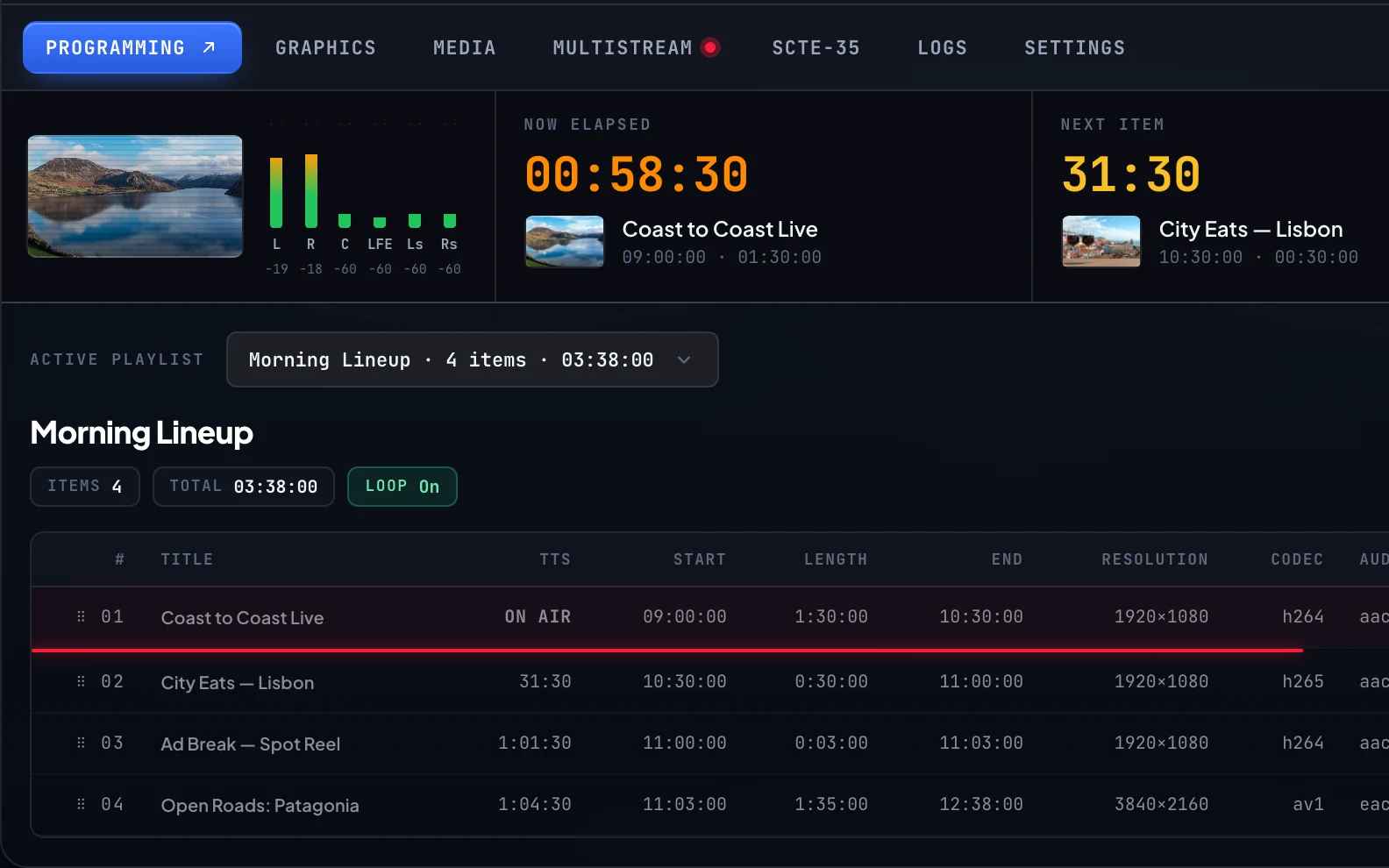
The LIVEPLUSTV cloud playout console with a channel on air
The engine

What cloud playout does, end to end

Four jobs, running continuously for each channel. Together they are what a master control room used to be.

  1. Plays the schedule

    The weekly grid airs exactly as built: recurring blocks, loops, auto-fill, and live slots. Changes go to air without a render step, and gaps never make it to screen.

  2. Renders the graphics

    Logo bug, lower thirds, ticker, and clock are burned into the picture server-side, so the channel looks the same on a smart TV as it does in VLC.

  3. Cues the breaks

    SCTE-35 markers ride the stream frame-accurately, placed in the schedule or passed through from a live feed. Channels that run no ads simply place no markers.

  4. Encodes and delivers

    Each channel encodes an adaptive ladder and hands off to a CDN serving 330+ cities with unlimited bandwidth. Every viewer gets the rendition their connection can carry.

Graphics

Broadcast graphics, the whole kit.

Every graphic is rendered into the picture server-side, so what you approve is what every player shows, from smart TVs to VLC. Nothing to install, nothing a device can drop.

Identity

Logo bug and clock

Keep the channel mark on screen with an optional broadcast clock beside it. It rides every show, scheduled or live, and it is how viewers know they are home.

Lower thirds

Names, titles, straps

Speaker names, show titles, verse references, breaking straps. Styled once to your look, then triggered whenever they are needed.

Ticker

A ticker that keeps moving

Run headlines, announcements, or scores across the bottom of the picture, and update the text without touching the stream.

Languages

Multi-script and RTL text

Arabic, Urdu, and Hindi render correctly out of the box, right-to-left included, and you can upload your own fonts so on-screen text stays true to your script and brand.

Per item

Graphics tied to shows

Attach graphics to individual playlist items, so a sponsor bug airs only during the sponsored show and drops when it ends. Per-item crossfades carry one show cleanly into the next.

Live

Triggered from the control room

Fire lower thirds, tickers, and overlays while you are live, from the same console that runs the schedule. No separate graphics operator seat required.

PROGRAMME LOGO + CLOCK LOWER THIRD TICKER RENDERER burned in, server-side EVERY PLAYER same picture
Four layers in, one picture out · not a player feature
The numbers

Codecs, audio, and transport.

The format story is deliberately boring: maximum compatibility on every plan, efficiency options when a channel grows into them. The plan-by-plan mapping is on the Cloud Playout pricing table.

Video

H.264 everywhere, up from there

Every plan encodes H.264, the codec effectively every device decodes. Higher plans add HEVC and AV1 for more picture per megabit, with adaptive ladders from 1080p30 up to 4K on Studio.

Audio

AAC, with surround on top

AAC stereo on every plan, the universal choice for HLS delivery. Studio adds 5.1 surround for channels where the mix matters.

In and out

Broadcast in, HLS out

Contribution over RTMP, SRT, or RIST, in push or listener mode. Out the other side: HLS in 2-second segments over a 330+ city CDN, with SCTE-35 cues riding end to end.

AI

AI where it saves real work.

No chat box bolted on the side. The AI features run inside the workflow: tagging media at upload, subtitling your programming, and translating when a channel needs a second language. Tagging and subtitles come in from the FAST plan; translate and dub arrive with Studio.

Tagging

Content tagged at upload

Shows get genre, rating, and category labels as they land in the library. The same labels drive the programme guide, make a deep archive searchable, and ride ad requests as brand-safety signals.

Subtitles

Subtitles without a transcriber

Automatic subtitles are generated for your programming, so viewers watching muted on a phone and viewers who are hard of hearing both stay in the audience.

Languages

Translate and dub

Studio channels can translate programming and generate dubbed audio, so one library can serve a second-language audience without a second production.

In plain terms

Cloud playout software, versus the rack

A traditional playout chain is a stack of purchases: an automation system, a video server, a character generator, an encoder, and someone qualified to keep them talking to each other. It works, which is why broadcasters ran it for decades, and it is why a new channel used to be a six-figure decision before a single show aired.

Cloud playout collapses that stack into a service. The same four jobs run per channel on infrastructure you never touch, the console is a browser tab, and a second channel is an afternoon’s work instead of a second rack. Updates land without a maintenance window on your side, and the cost sits on the pricing page instead of in a capex request. Weighing vendors? See LIVEPLUSTV vs Muvi and LIVEPLUSTV vs Amagi. Coming from a transponder? See satellite to streaming. New to the category itself? Start with the guide to what cloud playout is.

LIBRARY shows + schedule PLAYOUT SCTE-35 · graphics CDN 330+ cities SCREENS web · mobile · TV one live stream, 24/7
Schedule in, broadcast out

Built to stay on air

Everything about the engine assumes something will eventually go wrong at 3am. Schedule gaps auto-fill from the library, a bad file skips to the next item, a dropped live input falls back to the schedule and rejoins on recovery, and as-run logs record what actually aired so the answer to what happened last night is a report, not a guess.

Wired for the rest of the platform

The SCTE-35 cues playout carries are the same ones server-side ad insertion fills, the schedule it airs is the same one published as your channel’s programme guide, and every stream it hands to the CDN is counted by edge analytics. One engine, with the commercial pieces already attached.

EVERY CHANNEL INCLUDES
Questions

Cloud playout, answered.

What is cloud playout software?

Playout is the system that turns a schedule into one continuous broadcast stream: it plays each item at its slotted time, renders graphics into the picture, inserts ad cues, and encodes the result for delivery. Cloud playout runs that whole chain on servers instead of a rack in your building, managed from a browser.

How is this different from OBS or vMix?

OBS and vMix are production tools: someone operates them, live, for the duration of a show. Playout is automation that runs a channel 24/7 from a schedule with nobody at the desk. The two work together, not against each other. Many operators produce the live show in OBS or vMix and send it to the channel as a live input.

Are the graphics really part of the video?

Yes. Every graphic, from the logo bug to the ticker, is rendered into the picture server-side before encoding. There is no overlay layer for a player to drop or a device to render differently. What you approve is what every viewer sees, on every player.

Which codecs and resolutions are supported?

H.264 on every plan, because everything decodes it. Higher plans add HEVC and AV1 for more picture per megabit, adaptive ladders run from 1080p30 up to 4K by plan, and audio is AAC stereo with 5.1 surround available on Studio. The exact mapping is on the pricing page compare table.

What happens when a file is bad or the schedule has a gap?

The channel keeps going. Gaps auto-fill from your library or slate, a file that misbehaves is skipped for the next item, and a dropped live input falls back to the schedule. As-run logs record what actually aired, so you always know how the channel handled it.

Can I run more than one channel?

Yes. Plans are per channel, and each channel runs in its own isolated engine, so a busy sports channel cannot affect the music channel next to it. Operators commonly launch a second channel once the first is earning.

How quickly can a channel launch?

The same day, if your content is ready. There is no hardware to rack and no software to install: upload the library, build the grid, and start the channel from the browser.

What do the AI features do?

Three jobs today. AI content tagging labels shows with genre, rating, and category at upload, feeding the guide, library search, and the brand-safety signals on ad requests. Automatic subtitles arrive on higher plans. And Studio adds translate and dub for channels serving more than one language.

GET STARTED

Your channel can be live today.

No contract and cancel anytime, with a 7-day money-back guarantee on your first purchase.