CTV MONETIZATION

CTV monetization: your ad breaks, filled and paying for themselves.

Server-side ad insertion fills the breaks in your channel and bills you only when an ad verifiably plays. Smooth on every screen, aware of what your content is, and honest about the count.

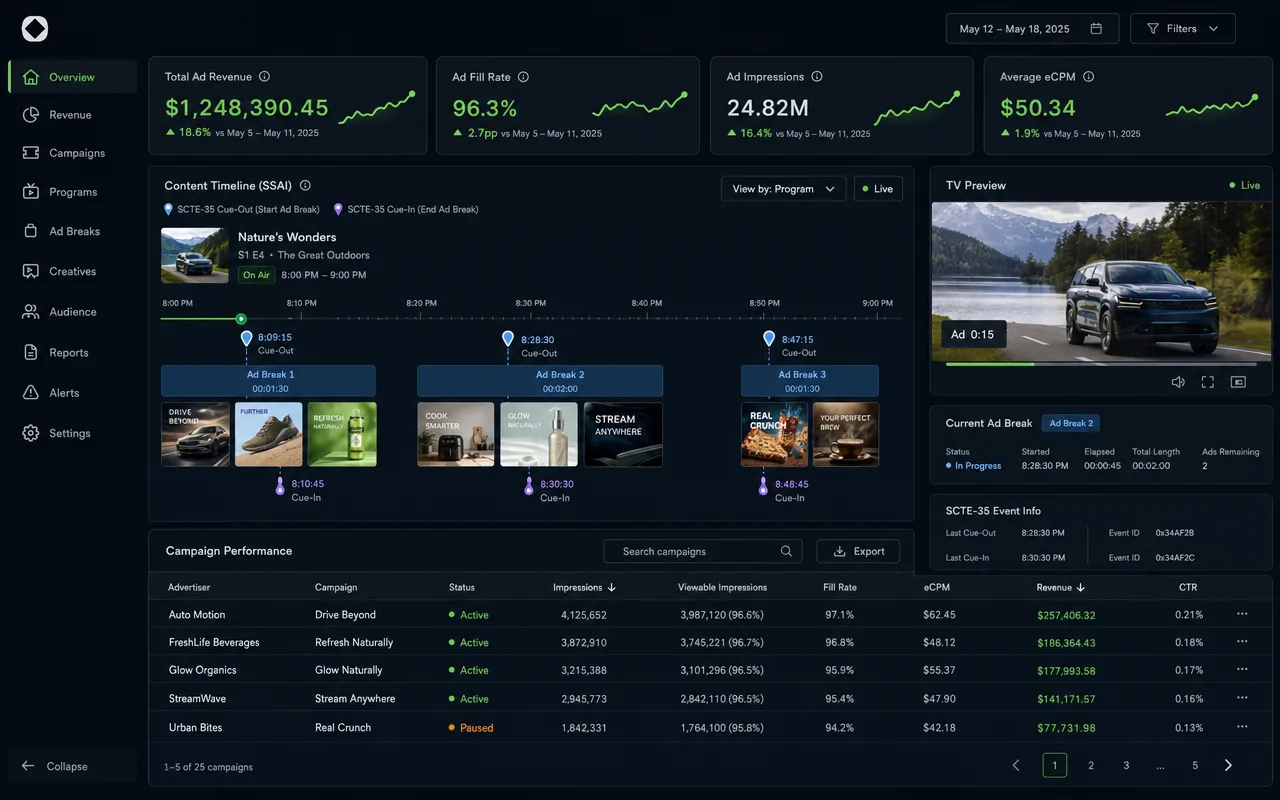
LIVEPLUSTV CTV monetization reporting: ad fill and delivery-confirmed impressions
Two ways to earn

Bring your own ads, or let us sell them.

Ad monetization is included on every plan. Pick the model that matches how you sell today, and switch later if that changes.

Bring your own ads

Keep 100% of your revenue

Plug in your own advertisers, network, or exchange over a standard VAST tag. Every dollar your inventory earns stays with you; we charge a flat serving fee for stitching the ads into your stream.

$1 per 1,000 ads shown

Counted only when an ad is delivery-confirmed. Unfilled breaks cost nothing.

Managed ads

We bring the advertisers

Hand monetization to our ad team. We fill your breaks with demand, run the day-to-day ad operations, and split the revenue with you. No upfront cost.

Rev share by invitation

Available by invitation as we onboard demand partners. Ask us whether your channel qualifies.

Run the numbers

What a filled break actually costs you.

Most usage-based platforms charge for serving, for every gigabyte delivered, and for a plan. On LIVEPLUSTV the plan and $1 per 1,000 are the whole bill. Enter what you pay today, add your CPM, and compare.

Average concurrent viewers
Video quality
Your channel
Their pricing
Our pricing
A month on air
Ad plays each hour · 2 breaks × 8 spots16
Impressions each hour · 16 plays seen by 300 viewers4,800
Ads shown / month · 730 hours, 60% of slots filled~2,102,400
Video delivered / month~493 TB
~$10,512 ad revenue / month at your CPM
Their bill
Ad serving~$1,051/mo
Delivery~$2,464/mo
Plan$0/mo
~$3,515 per month
Net after costs~$6,997/mo
On LIVEPLUSTV
Ad serving, $1 per 1,000~$2,102/mo
Delivery$0 · included
Plan$299/mo
~$2,401 per month
Net after costs~$8,111/mo
You save~$1,114/mo

Estimate only, on 24/7 delivery (730 hours per month) and the figures above. Ads count only when delivery-confirmed; unfilled breaks cost nothing on either side. Their plan defaults to $0, enter what you pay today. Our plan defaults to Launch at $299, billed monthly. Actual third-party costs vary by provider, volume and region.

Under the hood

How server-side ad insertion works

From cue to confirmed impression, the whole break happens inside your stream. Nothing is asked of the viewer’s device.

  1. The break is cued

    A SCTE-35 marker fires, either placed in your schedule or passed through from your live feed. The cue says exactly where the break starts and how long it runs.

  2. The ad request goes out

    The stitcher calls your VAST ad source carrying content signals (genre, rating, IAB category) plus device, country, and viewer privacy signals, so buyers know what they are bidding into.

  3. Ads are stitched in

    Returned ads are conformed to your channel’s renditions and spliced into the same HLS stream your content uses. There is no second player on the device and no buffering seam between content and ad.

  4. Impressions are confirmed

    When a viewer’s player fetches the ad from the edge, the impression is logged. That count drives your reporting, and on bring-your-own ads, your serving bill.

Explainer

SSAI vs CSAI vs SGAI: which one for a linear channel?

All three models put ads into a stream. Where the work happens, on the server, on the device, or split between the two, changes almost everything about how the break behaves.

Client-side ad insertion (CSAI)

With CSAI the ad decision happens on the viewer’s device. Content pauses, an SDK fetches the ad, a second player renders it, and content resumes. That can work well inside one big app with an engineering team behind it. It also means shipping and maintaining an SDK on every platform you care about, and every handoff between players is a chance to buffer. Because the ad request leaves the device in plain sight, ad blockers can kill it, which is why CSAI fill on the web is so unreliable.

CONTENT CDN AD SERVER PLAYER + ad SDK + 2nd player content stream ad request leaves the device · blockable
CSAI · the device does the ad work

Server-side ad insertion (SSAI)

With SSAI the ad is stitched into the stream before it ever reaches the device. The player sees one continuous HLS feed at one quality ladder, so a break looks like broadcast: no spinner, no volume jump, no separate ad player. It behaves identically in a smart-TV app, a browser tab, and VLC, because the player has nothing extra to do. And since no ad request ever leaves the device, there is nothing for a blocker to intercept.

CONTENT ADS · VAST STITCHER spliced on the server ANY PLAYER TV · web · VLC one stream
SSAI · the break happens inside the stream

Server-guided ad insertion (SGAI)

SGAI is the newest of the three, built on HLS interstitials. The server still makes the ad decision and marks exactly where the break goes, but instead of splicing the ad into the stream it hands the player a pointer, and the player fetches the ad itself when the cue arrives. That keeps content segments cacheable while allowing per-viewer ads, and it gives buyers the client-side beacons they are used to. The catch is in the fine print: interstitials need player support, and across the long tail of devices a linear channel lives on, that support is still arriving. The ad fetch also comes from the device again, which reopens the door blockers walked through in CSAI.

CHANNEL SERVER decides the break PLAYER plays the interstitial stream + interstitial cues AD SERVER player fetches the ad at the cue
SGAI · server decides, device fetches

Why linear channels choose SSAI

A 24/7 channel gets watched on whatever can decode HLS, including players you will never ship code to. SSAI is the one insertion model that monetizes all of them the same way today, which is why the major FAST platforms run their breaks server-side. SGAI is worth watching as interstitial support spreads through players; until it does, stitched breaks are what monetize the whole audience, and they are the only model LIVEPLUSTV uses.

The details

Built like broadcast, sold like digital.

Cue-driven

SCTE-35 in and out

Breaks fire on the same cue standard broadcasters use, whether the marker came from your schedule or rode in on your live feed.

Targeting

Content-aware requests

Genre, rating, and IAB category macros ride every ad request alongside device and geography, with AI tagging labeling shows at upload on higher plans. A buyer can tell a cricket stoppage from a cooking show, and bid like it.

Privacy

Signals passed through

Viewer privacy strings are forwarded to your ad source with every request, so your demand can honor them without you building anything.

Honest billing

Delivery-confirmed counting

An impression counts only when the ad is fetched for playback from the edge. Empty breaks and unwatched ads are never on your bill.

Reporting

As-run you can invoice from

Impression, fill, and revenue reporting per channel, backed by as-run logs of what aired and when. The number you bill against is the number the infrastructure measured.

Every player

One pipeline, every screen

Stitched breaks play anywhere HLS plays: TV apps, browsers, mobile, even VLC. There is no SDK to ship and nothing to maintain per platform.

Billing

What delivery-confirmed billing means

Most ad serving is billed on requests made or opportunities offered. We bill on the ad leaving the delivery edge for a real viewer. If a break is cued and your ad source returns nothing, you pay nothing. If an ad comes back but no player ever fetches it, you pay nothing. The $1 per 1,000 rate applies only to impressions the delivery log can prove. What a break is, who may fill it and when it returns all come from the SCTE-35 signalling underneath.

The same log backs your advertiser conversations. Every channel keeps as-run records of what played and when, next to impression, fill, and revenue reporting in the analytics dashboard, so the number on your invoice is the number the infrastructure measured.

Questions

Monetization, answered.

What is server-side ad insertion (SSAI)?

With SSAI, ads are stitched into the video stream on the server, in the same format and quality ladder as your content. The viewer’s player sees one continuous stream, so breaks play smoothly with no separate ad player, no buffering seam, and nothing for ad blockers to intercept.

What is the difference between SSAI and CSAI?

CSAI (client-side ad insertion) fetches and plays ads in the viewer’s device using an SDK built into the player. SSAI does the work on the server before the stream reaches the device. For a linear channel watched on many kinds of players, SSAI is the practical choice: it needs no per-platform SDK, behaves the same everywhere, and cannot be blocked client-side.

What is SGAI (server-guided ad insertion)?

SGAI is a newer model built on HLS interstitials. The server still decides the ads and marks the break, but the viewer’s player fetches the ad assets itself at the cue. It pairs server control with client-side measurement, and it depends on the player supporting interstitials, which is not yet universal across the devices a linear channel gets watched on. LIVEPLUSTV stitches ads server-side (SSAI), which plays in every HLS player today.

Do I keep my ad revenue?

With bring-your-own ads, yes, all of it. You plug in your own ad source, keep every dollar it earns, and pay a flat $1 per 1,000 serving fee only for ads that verifiably played. With managed ads, we bring the demand, run the ad operations, and split revenue with you.

What am I billed for exactly?

Serving is billed only for delivery-confirmed ads. An impression counts when the viewer’s player fetches the ad from the delivery edge, meaning the ad genuinely started playing in the stream. Cued breaks that go unfilled cost nothing, and ads no player ever fetched cost nothing.

What do I need to bring to start monetizing?

A VAST ad tag from your ad network, exchange, or direct deals. Point the channel at it and breaks start filling. If you have inventory but no demand yet, ask us about managed ads.

Where do the ad breaks come from?

From the SCTE-35 markers you place in your schedule, or from the cues already riding in your live feed. It is the same cue standard broadcast television uses, honored frame-accurately.

How do advertisers know their ads are brand safe?

Shows carry genre, rating, and category labels, applied by hand or by AI content tagging at upload on higher plans, and those labels ride every ad request. A buyer can see they are bidding into a TV-G cooking show rather than guessing, which is what brand safety means in practice.

GET STARTED

Your channel can be live today.

No contract and cancel anytime, with a 7-day money-back guarantee on your first purchase.