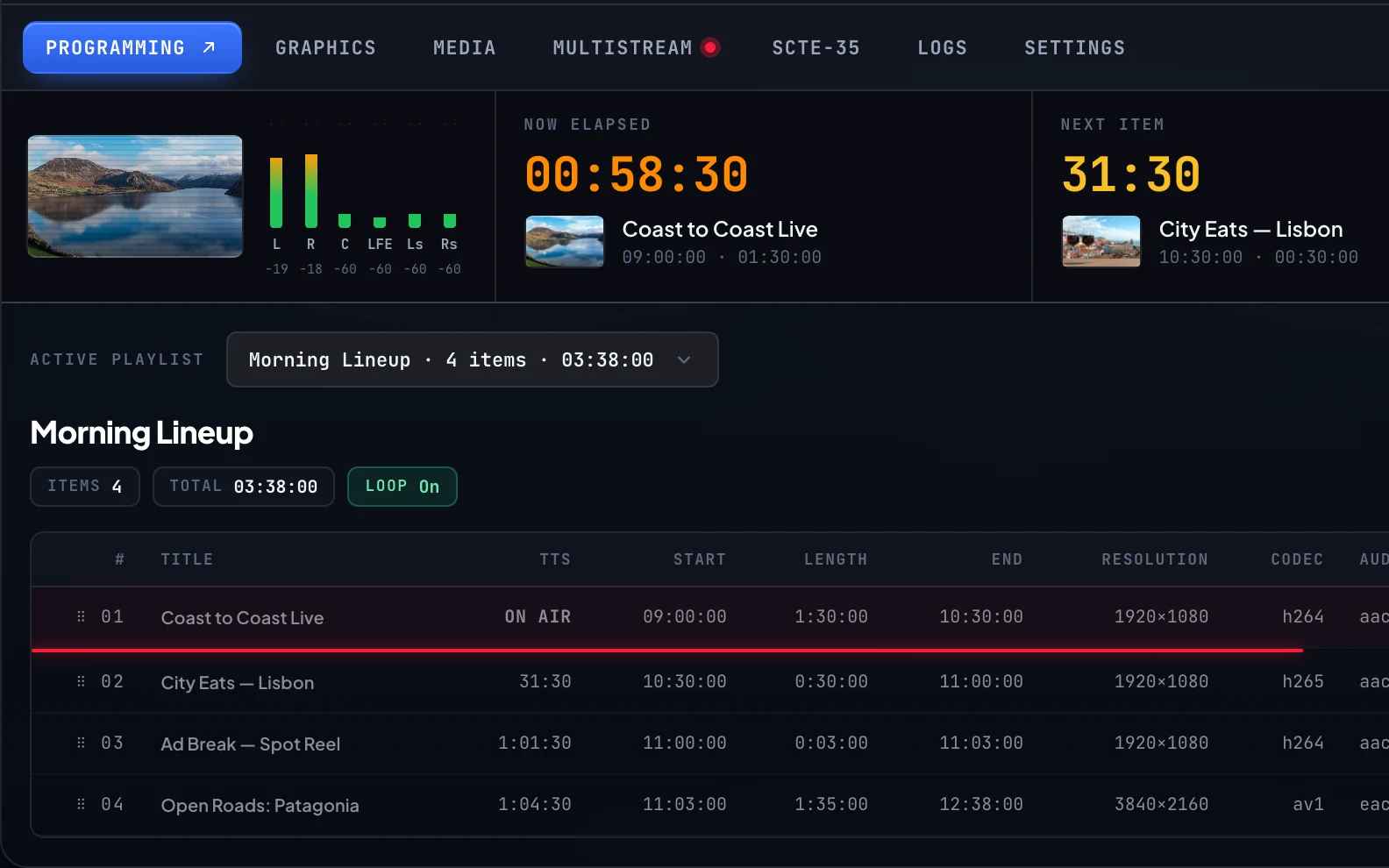
Social platforms are where clips go to be discovered, and you should keep posting them. But a congregation is not an algorithm’s audience. Elders and the community abroad want lean-back television: something that is simply on, in their language, that they can cast to the living-room TV and leave running. A 24/7 channel with a programme guide meets people the way they already watch. A feed of clips asks them to keep choosing.
A channel is also yours in a way an account is not. Nothing between you and the congregation ranks your service against entertainment, shortens your teaching to what retains, or changes the rules under you. You own the stream, the guide, and the audience relationship, and you still multistream the live service to social platforms at the same time, so nothing is given up to get it.
The service is protected while it airs
Live worship is the moment that matters most and the moment most likely to hit trouble: a shared connection at the hall, a cable someone kicks, a power blip. Playout treats your schedule as the safety net. If the venue feed drops mid-service, the channel falls back to your library or slate and rejoins the live input the moment it returns. The details are on the live streaming page.
Reaching the community that moved away
For most ministries the audience is bigger than the building: families who relocated, students abroad, grandparents back home. Delivery rides a CDN in 330+ cities with unlimited bandwidth on every plan, so distance costs nothing, and the city-level analytics map shows where the congregation actually is, which is often a surprise worth preaching about.
What it costs, and what it does not
Plans start at $254 per month billed yearly on the Cloud Playout plans, with delivery never metered. Ad breaks are entirely optional: they exist only where you place markers, and a channel with none plays clean. Running one costs less than most sound-desk upgrades, and it can be on air the same day the library is uploaded.